Wednesday, December 31, 2014

Mini Lessons Assignments

 We're turning the tables!  Each of you will present a 10-12 minute long mini-lesson about your topic.  We're going in a very specific order so that each lesson builds on the previous.  You'll need to use the book for the basic info about your topic and come up with the big idea (definition) of what your topic means.  Additionally, while it will be fun to hear from other folks, it's always fun to have a video, hands on activity and game.

These will start on the 12th of January.

Remember the basics:
  • 10-12 minutes in length
  • Present the main ideas of your topic
  • Choose one vocabulary term for your classmates to learn
  • Incorporate an activity, video, or mini game (you may NOT go over on time) into your presentation if you'd like
  • Wrap up your lesson by checking for understanding.  You can ask review questions or give a pop quiz of two  or three questions. 
  • You're also graded on your response and participation during the presentations from your peers. 
Other things to think about:
  • You can email me power points or links to pull up on the computer and Smart board in class. 
  •  If you need copies, you'll need 16 of them and you may make them at home or bring them to me to copy at least 1 day BEFORE your presentation.  I will not make copies for you on the day of presentation. 
Here's a link to the rough draft of the rubric.  It will give you an idea of what's important and how to approach the assignment for a great outcome.
https://docs.google.com/a/ccsoly.com/document/d/19P4KfrxnOiO4O9_soiWAZPZKYWs8_gUnwnalzPy_OlM/edit
If you need help, my planning period is from 1:20-1:50 daily as well as on Fridays from 12:35-1:15, and 2:10-2:50.

TOPICS and DATES were assigned in class December 17th and students were reminded on the 18th and 19th.  I will post them on the blog on or around January 5th. 


Monday, December 15, 2014

Earthquake!

Seismic waves
 p waves s waves

dip-slip fault
strike-slip fault
fault creep
normal fault
reverse fault
thrust fault

epicenter
focus
liquefaction
Mercalli and Richter scales
seismographs
surface waves  (Love  and Rayleigh)

Remember, look up the vocab to be an informed listener and participant in class discussion.

Friday, December 5, 2014

Can you feel the mountains tremble?

 This week it's all about how wiggly the world really is! Why don't we perceive it? These things move slowly and our lives are fairly brief compared to thousands of years it takes to make a mountain.  (And if it happened quickly, chances are good we wouldn't survive the crazy event to tell about it!)  But if we lived 900 years like Methusaleh, maybe we'd notice just how movable the mountains and continents are!

As usual, stuff is grouped together to help you organize it in your notes and in your head.


Continental Drift 
Tectonics
Convection Current


PLATE BOUNDARIES (the following are all types)
convergent--- with its friends subduction and trench
divergent-- with its friends seafloor spreading and midocean ridges
transform - it has no vocabulary friends

Stress- geologic not human! There are types because scientist LOVE to sort things into groups.
tensional
compressional
shearing

Deformation
Folding
Fracture
Hanging wall/footwall

Orogenesis
Mountain ranges
Plateau


Friday, November 21, 2014

Soil Composition and profile

Vocabulary  for Class November 24-December 5

Bedrock                                                              Soil profile

Humus  (hyoo-muss)                                          Subsoil

Organic material                                                 Topsoil

Pore space                                                           Regolith (review)

Horizon


Not in glossary but will be covered in class:

Silt                                                              Gravel
Sand                                                            Clay


  GRAVEL SOIL  pictured above

We'll also cover the specifics of the concept of soil horizons.   Check out the image below.
A, B, C, and O horizons in the soil


UPDATE 12/1

This week's big ideas:
Superposition
Geologic column
Fossils
Two views about the age of the earth


Tuesday, November 4, 2014

November Beginnings and End of Quarter Details

Finishing up:  The NOVA video from PBS, "Hunting the Elements"  was finally conquered in class today.  We will be going over these as a group tomorrow.  I know there's been a lot of illness, so I hope everyone is back in fine fettle tomorrow.  Those rascally RNA factories, those viruses; for being so microscopic, they sure can take us down.

Also finishing up: work for the quarter.  If you have any outstanding work, please make every effort to get it into my hands by Wednesday or Thursday.  I will have a journal grade day on Thursday where I assess your journal work.

Beginnings:  this (2nd) quarter we're moving into the larger picture of earth dynamics and processes.  We will have four days next week in class and three this week. New vocab for the next two weeks is listed below; we will have a quiz on  Thursday 11/12 over these concepts.

  We're going to be amateur rockhounds on Friday, November 14-- your general collection is due that day in class.  Remember, select and bring 12 different rocks that have been found, borrowed, or given, but not bought for this auspicious occasion.  Polished specimens are tougher to ID.   You're graded on participation and effort.

VOCAB: There are two main concepts with sub-concepts in the next couple of weeks.  There are also a couple of related terms.

weathering

  • mechanical weathering
  • ice wedging
  • chemical weathering
  • hydrolysis
  • acid rain
  • oxidation
  • carbonation
topography  (related term)

erosion
  • mass wasting
  • landslide
  • regolith
  • slump
  • mudflow
  • soil creep
  • earthflow
permafrost  (related term)


Monday, October 20, 2014

The next TWO weeks!

rcycle.jpg (499×380)

This is a little more detailed than we have, but it has the same general idea.

For Friday 10/24, you'll need to know the following terms and be able to place them in the right spot:

Sediments, sedimentary rock, deposition, compaction and cementation( which is where lithification is located up there in the diagram and means"turn to stone")  metamorphism, metamorphic rock, melting (bonus for locating magma), cooling (crystallization),solidification igneous rock, and weathering/erosion. You won't need to worry about the blue lines for the quiz.  It will look JUST like the study sheet we did today.

For Wednesday, 10/29, you'll need to know the longer list of terms.  I have grouped the terms together in their idea clusters-- the terms that are related to one another.  There are thirteen terms.

                           rock cycle                                               
                                                                                             mantle                                         
                                                                                             asthenosphere
                           P waves                                                    lithosphere
                           S waves                                                    the Moho (est. 1909!)


                           core                                                          crust
                          inner core                                                 continental crust
                          outer core                                                 oceanic crust

For Thursday and Friday, October 30-31, we will be watching a movie and taking notes to write a brief (200 words) paper about new concepts.  Come prepared to listen, enjoy, and write down solid ideas.  We'll write rough drafts on Monday 11/3, clean up and turn in on Tuesday 11/4.


Wednesday, October 15, 2014

Funny things minerals can do, types of rock, and there's gold (and other ores, alloys, etc.) in them thar hills!

Open note quiz tomorrow.  Please come ready to apply what we've learned to deeper thinking.

Special traits some minerals can have:
Smells (Odor)
Taste (Flavor)
Feel (Not just texture, but oiliness, greasiness, or similar)
Fluorescence
Phosphorescence
Radioactivity
Refractivity
Magnetic
Flexible (biotite)


Other traits that are more common to metals:
Malleability
Ductility

Also these words:
Ore
Alloy

ROCKS:
Types-- Igneous, Sedimentary, and Metamorphic


Friday, September 26, 2014

Maps and Minerals

Maps are very important to earth scientists.  We'll spend a couple of days investigating different types.   Then we'll move on to minerals and rocks. 

Map
Meridians
-Prime Meridian
Parallels
-Equator
Contour Line

Mineral
 **The 4 characteristics of a mineral are its definition. 

Inorganic
Crystalline Solid
Chemical Composition


Thursday, September 25, 2014

Friday Facts and Thoughts For Quiz 9/26


Terms and concepts for quiz this week 9/26

What is science?
What is earth science?
What is the difference between a law and a theory? (Being able to understand these two terms is critical to science classes in high school as well as your understanding of science in general.)
What is technology?
Branches of earth science: meteorology, geology, astronomy, oceanography, environmental science (ecology as it relates to human/earth interface)
Review:  6 steps of scientific method.

Key questions:  Can you ever prove a hypothesis?
Is running an experiment once and gaining a result proof?  Why or why not?

Tuesday, September 9, 2014

Some volcanic terms...quiz on Friday

Volcano
Magma
Lava
Crater
Hot Spots
Subduction Zone
Rift
Pluton
Pyroclastics
Volcanic Bombs-  known as tephra.

Here's a great video of some from Iceland in Eyjafjallajokull.  (Impress your parents- it's pronounced ee-I-forgot-my-yogle.)


Sunday, August 10, 2014

Field Trip to Mount St. Helens September 19, 2014 UPDATED

Yes!  We are visiting our friendly neighborhood volcano on Sept. 19, 2014.

Please see tentative broad schedule and other information below:

WHO:  5th-8th Grade Students and 5-7 Chaperones
WHAT: Learn about volcanos and ecology
WHEN: September 19. 2014  7:45 am-5:30 pm  (arrive earlier, departure is at 7:45)
WHERE: Mount St. Helens Johnston Ridge Observatory and Coldwater -Mount St. Helens Institute Learning Center
WHY: Part of science curriculum for both 5th grade and middle school includes learning about the dynamic nature of our planet's crust and how it impacts life.
HOW:  Carpool to  and from the sites, stopping for ice cream on the way home.

COST Approximately $7.00 per student.  We should be able to get a waiver for the fees to one of the sites. UPDATE:  Cost will be $8.00 per student, no cost to chaperones or drivers.  Fees are waived at one site we'll visit through a government grant and the other is a great opportunity to walk through the recovering blast zone on a hike!

Chaperones and drivers are lined up and ready!  Thank you to those parents and teachers coming along.  We will be hiking a little over 2.5 miles.  Dress for a hike in layers, sturdy shoes, and bring a water bottle.  A jacket is not a bad thing to bring along as conditions change very rapidly up at altitude. Lunches should be edible right "as-is", no microwaves or stoves are available.

Monday, June 2, 2014

Last Quiz-- Helpful things!

A couple of graphics to help with tomorrow's quiz.
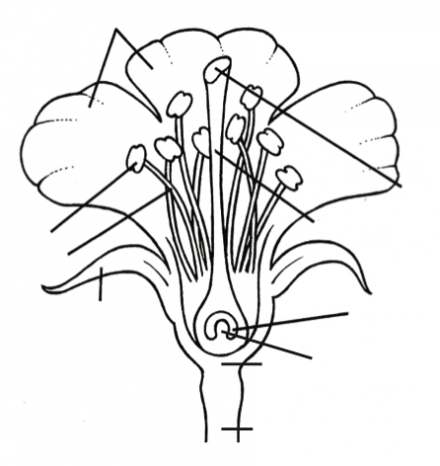
 You don't have to know the filament, the anther, or that this is a "perfect flower!"
Be able to tell what the parts of a flower do as well as label them correctly. 
The water molecule is bonus, worth more if you can explain why its polarity is important to plants. 


Wednesday, May 28, 2014

Plant reproduction

Vocabulary- Words are grouped into related things

Sepals
petals

Pollen
Stamen

Pistil
Style
Stigma
Ovary
Ovule
Embryo

Wednesday, May 21, 2014

Plant structure and metabolism

THIS WEEK: Plant Structures and Metabolism

terminal bud, epidermis, mesophyll, stomata, monocots, dicots,  photosynthesis, chlorophyll, transpiration, cellular respiration, transport

Also, the chemical equation for photosynthesis:

6H2O +6CO2-------------------> C6H12O6+6O2
                              (sunlight and chlorophyll)


Please bring plants and pizza boxes to school in time for class on Friday.  Plants should be pressed, dried, and in a ziploc bag with your name on it. 

Wednesday, May 14, 2014

Plant Collection Project


  • Press all specimens in a large book at home using paper towels or newspaper.  Mosses may require a paper towel/wax paper combo to avoid damage to the book.
  • Collect both flower or cone and a leaf or set of leaves or needles (fiddle head and capsule if possible for ferns and mosses)
  • Five different kinds:  must include a fern, an evergreen cone-bearing plant, a flowering plant, a moss, and one free choice  which is different from the others
  • DUE Friday May 23 In class!   Bring to class in a large ziploc bag labeled with your name.   We will mount them in our boxes in class and identify them with Latin names.

    **Wednesday was a note taking day and we spent time in class discussing the concepts and finishing a graphic organizer for some of our vocab. I do expect you to take notes and look up the vocabulary I assign in class. The graphic is not transferable to the blog as it is hand-drawn.

    Roots Rhizomes Fronds Leaves Bark Cambium Xylem Phloem Pith Sapwood Heartwood Epiphytes

    The six needs of plants per the notes we took in class on Thursday


Wednesday, May 7, 2014

New Vocabulary for Plant Unit, Pizza Boxes


  • Bring a cleanish pizza box to class to house your future plant collection!   Label with your name using a Sharpie. 
  • Cascade Lab on Friday 5/09


Plants are often uniquely described in this/that terms.  It either has "this" or  it has "that."
Much of our vocabulary is built on contrasting traits of plants, so learning one means learning the other.  I will pair them together, but you need to understand the differences.  

For example, if a plant has a vascular system that moves fluids and nutrients through the organism, then what does a non-vascular plant do?


  • Definition of a plant
  • Sporophyte/Gametophyte (latin is helpful)
  • Vascular/nonvascular
  • Spore/seed  
  • Gymnosperm/angiosperm (latin is helpful)
  • Annuals/biennials/perennials  (this, that, and the other)
  • Humus (hint: not hummus, the yummy dip)
  • Fragmentation

please check out this link to the slide show from Thursday if you aren't sure. 
Plant basics

Sunday, March 23, 2014

Excellent JOB!

Wow!  You guys did a great job! I was terribly impressed with all the things I saw, and I know our judges were very enthusiastic but also hard-pressed to make selections.  Inquiry to investigation, and thoroughness were the hallmarks of what they were looking for; you guys made it tough to pick.

That being said, I know it's not easy to pour a lot of work into something and not get the results or accolade you hoped to receive.  I've completely been there myself.   If I had a nickel for every time I'd tried something and failed,  I could buy us all a Blizzard (the big kind)!  But I think I can honestly say that I learned more from my "not-quite" experiences than  my "easy" ones.   And I'm not  alone.

 I read an essay about a noted scientist last week-one who's authored several books, done landmark work in genetics, and been president of universities, etc.- and he loved lab science dearly.  He was hired by a research university to study DNA.   He found himself at a critical point in his career with his research going very badly.   It's "a reality every scientist encounters. " It was a very upsetting and discouraging time, but in the midst of it, he realized that not only had he lost his research footing, he'd lost his faith, and he missed a relationship with the living God desperately.  He had put his faith in the wrong thing: himself.

He dropped to his knees and began that moment to seek Christ again, and live every day as if He were real.

I've been privileged to have gotten taught by him for a week.  His science would blow you away, but what you remember is the grace and humility of Chris that shines through his words and his careful consideration of how best to be Jesus to those around him.  His failure led him back to the source.  God led him to new opportunities, and his family also came to Christ.

And science fair is important, and learning is amazing.  I am continually geeked out about what God has made and how Christ holds it all together and it's fun to open those surprises in class together.

But Christ is all.  May you realize that no matter how incredible creation is, it is only a joyful reminder of the Love that holds it all together. And I pray that in the growth of joy or disappointment, you may realize His joy in you.  Keep seeking!

 And periodic table all the way to Xenon this week, then we are calling it a great start to getting acquainted with Mendeleev's great idea.

We'll finish with investigation of harmful substances, then prepare for a nutrition unit.  Between DC, Spring Break, and conference week,  middle school will have one open book quiz on Thursday 3/27, last periodic table quiz (unless you want a challenge, then see me), and 6th and 7th grade students will have an assignment to prep for nutrition that Anna, Livi, and the other eighth grade students have completed with Mrs. Anderson.

New class focus beginning April 21.

Friday, March 14, 2014

SCIENCE FAIR IS NEXT WEEK!

 Science fair is next week!  So exciting! I cannot wait.  I will be ribbon shopping this weekend!


We won't have a quiz next week over vocabulary.   On Tuesday, we will have a periodic table test over #1-46 including technetium, ruthenium, rhodium, and palladium as our newest.  It also includes some random but oldies out of the most common.  (Tin, platinum, plutonium, gold, silver, iodine, uranium, radon, and radium.) We're almost to the halfway point, which is our contribution to your high school chemistry and beyond!  You've done a great job with this.

Most of you did a great job listening and participating today with our guest speaker on autoimmune disease.  Thanks, parents, for letting your kids take a gander at their blood sugar.  Hopefully, they came away better informed  and determined to avoid the preventable forms of such diseases.

UPDATE!

I've uploaded the grading scale for your science fair projects below.


Problem: Finds an original problem to investigate which is interesting to the student and which can be tested (10 pts.)

Hypothesis development: Developed a hypothesis as an educated guess with a reason for that guess. (10 pts.)

Description of Procedure: Procedures were outlined in a step-by- step fashion that could be followed by anyone without additional explanations. (10 pts.)

Data Collection: Data was collected several times. It was summarized independently, in a way that clearly describes what was discovered. (10pts.)

Data Representation: Data was organized into a data table and a graph was made (if appropriate) and correctly labeled. (10 pts.)

Diagrams or Pictures: Provided accurate, easy-to-follow diagrams, pictures, or drawings that showed parts of the experiment. (10 pts.)

Display Board: Each of the parts of the experiment are neatly and clearly written and labeled. (20 pts.)

Scientific Report: Each step of the experiment is neatly, clearly, and accurately presented using the required format. Spelling and grammar are correct. (20 pts.)


Wednesday, March 5, 2014

Immune system

Science fair countdown: 10 days!

This week's periodic table elements: 1-42 plus the nine additional common elements.  (See previous blog post if it's a head scratcher.)

This week we're studying the immune system, starting on p. 370. 

Vocabulary includes:

lymphatic system, lymph, lymph nodes, tonsils, thymus, spleen,  allergen, antibiotics,  active immunity, passive immunity,  white blood cells, macrophages, t-cells, b-cells, antigens, antibodies. 

Don't just" know what these mean"; listen in class, think and seek to make sense of how they work together. 

Also:  the lymphatic system is your body's secondary line of defense.  What's the first?


Monday, February 24, 2014

Science Fair, Outbreak Unit, and Periodic Quiz

Science fair is in less than four  weeks.
Please take time to check in with me if you have questions.

Parents, I sent home a packet for  middle school students to keep them on track and assist them in making sure their project lines up with specifications.

We're doing a unit on infectious disease called, "Outbreak".  It's an event based module where we learn about how disease is spread and how to deal with infectious disease.  We studied patient profiles and lab results to determine that our fictional town had an outbreak of tuberculosis; groups identified patient zero and tracked the spread of disease.

This week we'll be reading about  Ebola, running a lab to determine what types of potentially infectious agents live in water and food around us (and what kind of friendly critters live there, too) and finishing up with a lab report.

Students will also have a periodic table test this week on 1-42 plus a few of the most common: Platinum, plutonium, uranium, tin, radon, radium, gold, silver, iodine

New for this week and last week include rubidium (Rb 37) strontium (Sr 38) yttrium (Y 39) zirconium (Zr 40) niobium (Nb 41) and molybdenum (Mo 42).

Thursday, January 30, 2014

Scientific Method

 Quiz Next Tuesday over the Scientific Method.
 
 You can boil it down to six words.  (Kind of.)
1. question
2. research
3. hypothesis
4. experiment
5. analysis (of data collected)
6. conclusion

For details on the six words (because you do really have to know what they mean and how they fit together) please see your purple textbook beginning on p. 14.

Also submitted for your learning needs:
 What is the difference between scientific method and scientific inquiry?
What is the difference between qualitative and quantitative observations/data?

Possible short essay:  Why is it important for an experiment to be repeatable with the same results? 

Periodic Table this Friday: uranium  U 92
                                            gold       Au  79
                                           silver       Ag  47
                                             tin          Sn   50

Thursday, January 16, 2014

BioChem Lab Week!

No quiz this week.  Hooray!

It's lab week!  Double hooray!

It's  kind of gross, but really interesting.

Where did the victim eat his last meal????

See you in the forensics lab.

Wednesday, January 8, 2014

Here are some questions for next Tuesday's quiz.  Please be advised that there will also be questions about the nature of amino acids and proteins.  You should also study the mini-book about these subjects and stay tuned in class about "big ideas".  I will alert you to this!

Amino Acids-- how many pairs of DNA make up a code for each amino acid?

How many bases of DNA are there?

What do chains of Amino Acids create? 

What is replication of DNA?  
What is transcription of DNA?
What is translation  of DNA?
What do the last two things do?  Why are they important?

Why is it important to make a copy of DNA into RNA to "read" for amino acid production and other tasks?

What is the main function of enzymes?  Why is it important?

Explain how enzymes work-simple is best!


FOR FRIDAY 1-17-14

Add Uranium to the PT
Here are the links to the DNA learning center website's videos:

There is also a basic translation and basic transcription  video broken down into the two different phases.  Transcription occurs, then translation.  First the photocopy is made of the instruction manual pages, and any junk edited out= transcription.  Then the instructions are read and the protein assembled=translation. These processes go together.  Look on the options on the left side of the webpages under 3-D animations.  There are lots more there, too!